• Samstag, 19. Juni 2027<br/> 19.30 Uhr Vaduz (FL) <br/><br/> Orgelkonzert

    Samstag, 19. Juni 2027
    19.30 Uhr Vaduz (FL)

    Orgelkonzert

    Vaduz - Kathedrale Sonntag, 4. Juli 2027, 18.00 Uhr Orgelkonzert Programm Johann Sebastian Bach Die Kunst der Fuge (1750) (1685-1750) Fuge Nr. 1 Fuge Nr. 18 (Ergänzung durch Alexandre F. Boëly) César Franck Choral a.Moll (1890) (1822-1890) Olivier Messiaen Livre du Saint Sacrement (1984), daraus (1908-1992) Prière (Nr. 16) Josef Gabriel Rheinberger Sonate A – Dur op. 188 (1901) (1839 – 1901) Präludium Intermezzo Pastorale Finale Rudolf Innig, Orgel (www.rudolf-innig.de) Gedanken zur Musik

    Details

  • Sonntag, 4. Juli 2027<br/> 18.00 Uhr Coesfeld <br/><br/> Orgelkonzert

    Sonntag, 4. Juli 2027
    18.00 Uhr Coesfeld

    Orgelkonzert

    Coesfeld St. Jacobi Sonntag, 4. Juli 2027, 18.00 Uhr Orgelkonzert Programm Johann Sebastian Bach Die Kunst der Fuge (1750) (1685-1750) Fuge Nr. 1 Fuge Nr. 18 (Ergänzung durch Alexandre F. Boëly) César Franck Choral a.Moll (1890) (1822-1890) Olivier Messiaen Livre du Saint Sacrement (1984), daraus (1908-1992) Prière (Nr. 16) Josef Gabriel Rheinberger Sonate A – Dur op. 188 (1901) (1839 – 1901) Präludium Intermezzo Pastorale Finale Rudolf Innig, Orgel (www.rudolf-innig.de) Gedanken zur Musik

    Details

  • Freitag, 27. August 2027<br/> 20.00 Uhr Lüneburg<br/><br/> Orgelkonzert

    Freitag, 27. August 2027
    20.00 Uhr Lüneburg

    Orgelkonzert

    Orgelkonzert St. Nicolai Lüneburg Freitag, 28. August 2026, 20.00 Uhr Programm: Max Reger Fantasie über B-A-C-H op 46 (1900) (1877-1916) Felix Mendelssohn Sonate c-Moll op 65 Nr. 2 (1844) (1809-1847) Grave-Adagio Allegro maestoso e vivace Fuge (Allegro moderato) Felix Nowowiejski Sinfonie e–Moll op. 45 Nr. 5 (1929) (1877 – 1946) Allegro serioso Andante ('Stella matutina' - 'Morgenstern') Passacaglia Rudolf Innig, Orgel

    Details

Dear reader,

Welcome to my website!


In addition to the information about concerts, you will now find information about my various publications, structured into the following categories:

  • CD and SACD recordings

My CD- and SACD recordings are released by the MDG label (www.mdg.de). 

You will also find here some recordings (such as the early organ cycles by Olivier Messiaen or the complete organ works by Johannes Brahms), which I can offer as records in the classical LP-format.


  • Sheet music

You will find under organ transcriptions  several of my new editions of Anton Bruckner symphonies (F minor WAB 99, D minor WAB 100 and C minor No. 1 WAB 101) as well as transcriptions of various orchestral or piano works by George Gershwin, Otto Kitzler, Giacchino Rossini, Karol Szymanowski and Richard Wagner.

You will find under Organ Music  my own editions with previously unpublished organ works by Samuel Barber, Franz Lachner and Felix Nowowiejski.


  • Printed things

Here I would first like to point out my book Anton Bruckner's Path to become a Symphonist (www.vpe-web.de), which you can now order directly from me.

In the American magazine Bruckner Journal (www.brucknerjournal.com) my articles Where is the third theme - about a misunderstanding in the symphonies of Anton Bruckner and Anton Bruckners organ improvisations were published.

You can also find in this section my articles on organ music by Felix Nowowiejski, Olivier Messiaen or Josef Gabriel Rheinberger.


Enjoy reading, browsing or listening!


Dr. Rudolf Innig

(January 2026)
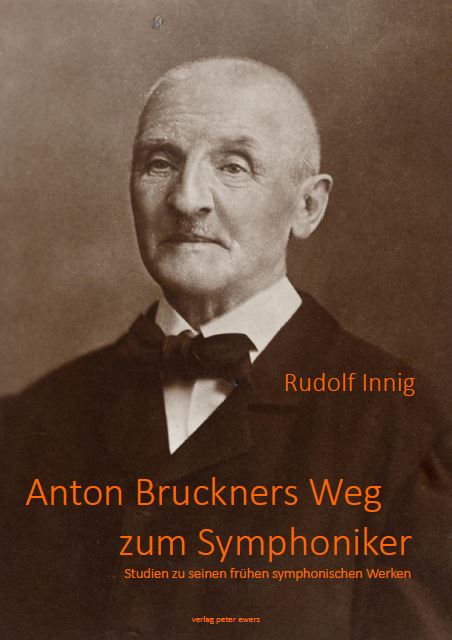


Anton Bruckner's path to becoming a symphonic composer

532 pages
(Text volume: 386 pages with many musical examples
Appendix: 148 pages with transcriptions from the Kitzler study book)

Continue Reading

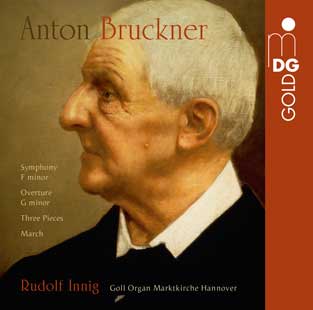
Anton Bruckner - Symphony in F minor (WAB 99)


(ca. 80 pages, 30 €)

Unlike today, Anton Bruckner was known in his time not as a symphonist, but primarily as an organist. At the age of 21 (1845) he was appointed organist at the Augustinian monastery in St. Florian, where he had previously been accepted as a choirboy after the early death of his father in 1837. In 1855 he became organist at the cathedral in Linz and finally in 1869 with the title 'k.u.k. court organist' in Vienna.

In December 1861 Bruckner began further studies in free composition with the Linz theater conductor Otto Kitzler, who was 10 years younger than him, which gave him the decisive impulses for composing symphonic orchestral works.

The Kitzler study book, which was only published in 2014, traces this development on 326 pages with handwritten exercises, sketches and compositions by Bruckner. At the beginning (based on the composition and form theories of E. F. Richter, J. Chr. Lobe and A. B. Marx) there were exercises in period structure and the two- or three-part song form. This was followed by song compositions, sets of variations, a piano sonata, a string quartet and studies in instrumentation based on the Piano Sonata in C minor op. 13 by Beethoven.

The two-year lessons with his friend Kitzler ended in the spring of 1863 with Bruckner's first symphonic works, the orchestral pieces (WAB 96 and 97), the overture in G minor (WAB 98) and the symphony in F minor (WAB 99).

Here are the first pages of the Symphony in F minor in my transcription for organ.


Early Orchestral Pieces

(arr. for organ)
Goll Orgel
Marktkirche Hannover

Continue Reading

A la vierge Marie

Noriko Fujii, soprano, Rudolf Innig, organ


Arthur Honegger: Trois Psaumes,

Marcel Dupré: Ave Maria, Jean Langlais: A la Vierge Marie,

Jehan Alain: Ave Maria,

Louis Vierne: Les Angélus,

Lili Boulanger: Pie Jesu,

André Jolivet: Messe Pour le Jour de la Paix,

Darius Milhaud: Cinq Prières


Louis Vierne (1870 – 1937) based his work on a spiritual poem by Jehan le Povre Moyne entitled ‘Les Angélus’. The three poems each describe the mood of people at the time of the Angelus ringing and the music tries to convey this.

Lili Boulanger (1893 – 1918), the younger sister of the famous pianist Nadja Boulanger, was the first woman to win the famous French composition prize ‘Prix de Rome’ at the age of just 20. She composed numerous works for choir and voices, but also purely instrumental works. In the last months of her ailing life, she wrote (alongside work on an unfinished opera) her own Requiem Pie Jesu for mezzo-soprano, string quartet, harp and organ (recorded here in a version for organ alone...

Jean Langlais (1907-1991), who had close contacts in America throughout his life, composed a very personal form of the Ave Maria in 1981 for the singer on this CD, Noriko Fujii.

Based on his own text, which freely expands the invocation and request of the liturgical Ave Maria, Jean Langlais wrote a short piece in which the requests are initially sung as if reciting the same melodic phrase, but which is then expanded into a large melodic gesture in the final request.  (Dr. Irmlind Capelle)